The soil contrast between Richmond's Shockoe Bottom and the West End is stark, and it defines how a ground improvement strategy must be engineered. In the low-lying Bottom, deep alluvial silts and loose hydraulic fill overlie the Petersburg granite, while the higher West End sits on residual sandy silts derived from weathered bedrock of the Piedmont. A vibrocompaction design that works for the relatively clean, uniform sands near the James River floodplain can be completely inadequate for the micaceous silty sands found just two miles west. Our laboratory team runs full gradation curves, fines content checks, and Atterberg limits before any field program begins because Richmond's geologic transitions are simply too abrupt to rely on regional assumptions. When the subsurface shifts from fluvial terrace deposits to Triassic basin sediments within a single site, the vibrator spacing, frequency, and feed material specification must be recalibrated. We often recommend a pre-design CPT test campaign to map the loose zones continuously, and we pair that data with grain size analysis to confirm that the soil matrix can densify effectively under vibratory energy. For sites where the natural sand is too silty to reach the 70% relative density target, we evaluate a combined approach using stone columns to provide drainage and reinforcement simultaneously.
Vibrocompaction in Richmond demands a design that reconciles the abrupt geologic boundary between Piedmont residuum and Coastal Plain sediments, often within a single construction site.
Technical details of the service in Richmond Virginia
Critical ground factors in Richmond Virginia
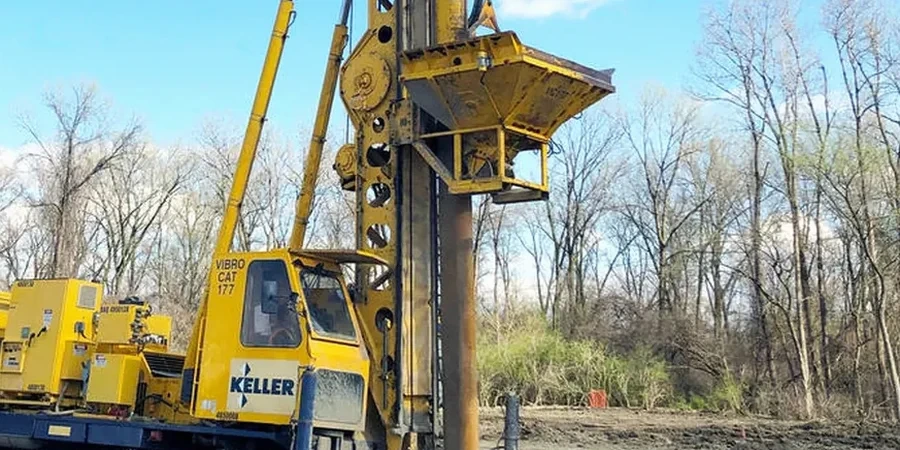
The electric or hydraulic vibrator used on Richmond projects typically weighs between 8 and 15 tons and is suspended from a crawler crane with a 60- to 90-foot boom, which positions the probe precisely over each compaction point. Our technicians monitor the ammeter in real time as the vibrator penetrates under its own weight assisted by water jets or compressed air; a sudden spike in current draw often signals a cobble or a weathered rock lens within the Triassic saprolite that could damage the eccentric weights if the feed rate isn't reduced immediately. The biggest operational risk in the Richmond area is differential settlement improvement across a site where the soil transitions from clean fluvial sand to silty residual soil over a distance of less than 100 feet. Without a rigorous pre-design investigation that maps these transitions, the vibrator grid may leave untreated lenses that compact differently under structural loads, creating angular distortion that exceeds the 1/500 limit for conventional framed buildings. We protect against this by running the vibrocompaction design iteratively: the initial CPT or SPT profile defines the first grid, the real-time energy consumption data refines the spacing, and the post-compaction sand cone or CPT re-test quantifies the achieved improvement before the foundation subgrade is accepted.
Our services
Our vibrocompaction design process integrates laboratory index testing, field exploration, and real-time compaction monitoring. We deliver a site-specific specification that accounts for Richmond's geology and the project's structural demands.
Pre-Design Soil Suitability Analysis
Full gradation, Atterberg limits, and moisture content profiling to determine if the on-site sand falls within the vibrocompaction treatability envelope, with a written go/no-go recommendation backed by ASTM D2487 classification.
Compaction Grid and Energy Specification
Development of vibrator spacing, penetration depth, hold time, and withdrawal rate parameters calibrated to the CPT tip resistance and SPT N-values measured at the Richmond site.
Post-Compaction Verification Testing
Field density testing, CPT re-profiles, and relative density calculations to confirm that the specified improvement has been achieved uniformly across the treated footprint before foundation construction begins.
Common questions
What soil types in Richmond are suitable for vibrocompaction?
The method works best in sands with less than 12 to 15 percent fines passing the No. 200 sieve. In Richmond, the fluvial terrace sands along the James River and the Cypresshead Formation sands in the eastern part of the metro area are generally suitable. Sites with Triassic siltstone saprolite or high-plasticity clay lenses require a different ground improvement approach.
How deep can vibrocompaction treat the loose sand?
With standard crawler-crane-mounted vibrators, we can typically reach depths of 60 to 65 feet below the working grade. Deeper treatment is feasible with purpose-built leaders, but most Richmond construction sites fall within the standard range given the depth to the Petersburg granite or Triassic bedrock.
Does vibrocompaction trigger settlement in adjacent buildings?
Vibratory energy attenuates with distance, but in Richmond's historic districts like Church Hill with sensitive masonry, we establish vibration monitoring arrays and set peak particle velocity limits at 0.5 inches per second at the nearest structure. We also adjust the vibrator frequency to avoid resonant frequencies that could amplify ground motion.
What does vibrocompaction design cost in Richmond?
A complete vibrocompaction design package including laboratory gradation analysis, CPT or SPT pre-design exploration, grid specification, and post-compaction verification typically ranges from US$1,320 to US$4,710, depending on the treated area and the number of compaction points requiring verification testing.
How long does the design and verification process take?
The laboratory characterization and initial grid design are usually completed within 7 to 10 working days after receiving the soil samples. Field verification testing follows the contractor's schedule, and the final report documenting the achieved relative density is delivered within 5 working days of completing the post-compaction testing program.