A mixed-use development near the James River hit a layer of micaceous sandy silt at 22 feet—standard SPT blow counts looked okay, but the silt was borderline contractive. The structural team needed drained and undrained strength parameters before finalizing the mat foundation grade. That’s where the triaxial test comes in. We run CU and CD programs in our ISO 17025-accredited lab to isolate effective stress paths and pore pressure response, giving engineers the c’ and φ’ values required for Richmond’s residual soils and alluvial deposits. When the stratigraphy gets tricky—and in the Fall Zone it often does—standard correlations aren’t enough. A full triaxial test program provides the strength envelope the design actually needs, not a textbook approximation. For deeper borings we pair results with the CPT test to cross-check tip resistance against lab-measured undrained shear strength.
A triaxial test from the Piedmont saprolite isn’t just a strength number—it’s the difference between a footing that settles two inches and one that differentials into structural distress.
Technical details of the service in Richmond Virginia
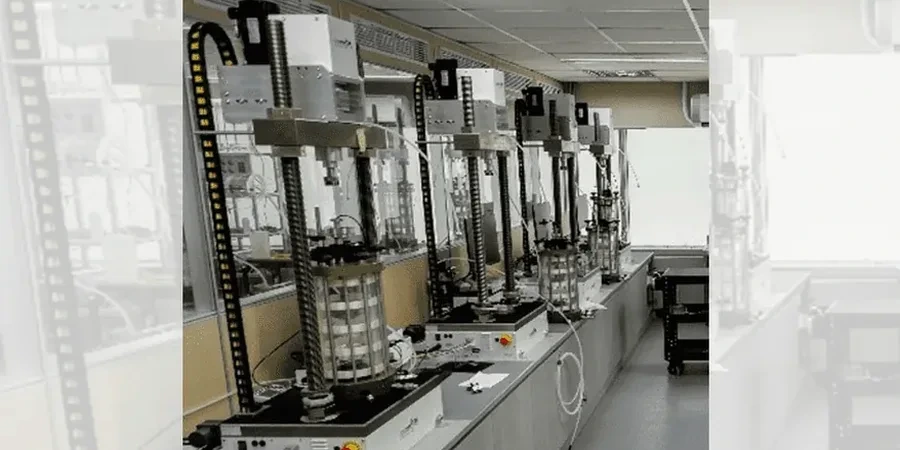
Field demonstration
Critical ground factors in Richmond Virginia
Richmond’s location straddling the Fall Zone creates a geotechnical risk profile that catches out-of-state engineers off guard. The contact between Coastal Plain sediments and Piedmont crystalline rock runs right through the city, so two borings 300 feet apart can hit completely different soil mechanics problems. Triaxial test results from the Coastal Plain side often show normally consolidated clays with low undrained shear strength and positive pore pressure generation during shear—classic contractive behavior that demands effective stress analysis for any excavation deeper than 12 feet. On the Piedmont side, partially saturated saprolite can exhibit misleading apparent cohesion that disappears after heavy rain events common in Virginia summers. Core Creek, the marine clay unit underlying much of eastern Richmond, generates Skempton A-factors above 0.8 at failure, meaning pore pressure spikes during rapid loading. Skimp on the triaxial test program here and you’re designing blind to the single parameter that controls short-term stability. The IBC references ASCE 7 for seismic site class determination, but it’s the lab-measured undrained shear strength from a triaxial test that actually confirms whether that Class E profile is as soft as the SPT numbers suggest.
Our services
The triaxial test is the core of any critical-state soil mechanics program, but it rarely stands alone. We integrate lab testing with field investigation and advanced analysis to deliver a complete geotechnical model for Richmond projects.
CU and CD Triaxial Testing Programs
Multi-stage consolidated-undrained and drained triaxial compression on 2.8-inch undisturbed specimens. Each program includes B-value saturation checks, consolidation to in-situ stress, strain-controlled shear at 0.5–2% per minute, and full pore pressure monitoring. We deliver Mohr-Coulomb envelopes, stress paths, and stiffness degradation curves ready for PLAXIS or FLAC input.
Critical-State Parameter Determination for Richmond Soils
For projects requiring advanced constitutive modeling—Modified Cam Clay, NorSand, or HS-Small—we run specialized triaxial programs with unload-reload loops, K0 consolidation, and critical-state line definition. This service targets deep excavation design in Core Creek clay and seismic deformation analysis where simple Mohr-Coulomb parameters underestimate ground movement.
Common questions
What’s the difference between CU and CD triaxial test conditions?
Consolidated-Undrained (CU) with pore pressure measurement, per ASTM D4767, lets us separate total stress from effective stress and gives you both c’/φ’ (effective) and c/φ (total) parameters. It’s the standard choice for short-term stability analysis in Richmond clays. Consolidated-Drained (CD), per ASTM D7181, runs slow enough to fully dissipate excess pore pressure during shear, so it measures the true drained strength envelope for long-term settlement and slope stability problems in Piedmont residual soils.
How much does a triaxial test program cost in Richmond?
A standard three-specimen CU program with pore pressure measurement runs between US$1,890 and US$2,880, depending on whether we need to trim Shelby tubes on-site or run additional unload-reload loops for stiffness measurement. CD programs fall at the upper end of that range because of the longer shear stage. We’ll give you a firm quote once we see the sample recovery and know the target confining pressures.
What sample quality do you need for a reliable triaxial test?
We require undisturbed samples—Shelby tubes pushed with a smooth hydraulic system, not driven, with a minimum recovery ratio of 85%. Samples must be sealed with wax or microcrystalline coating immediately after extraction and transported upright in cushioned carriers. Disturbed bag samples won’t work for shear strength; we’d remold them and that defeats the purpose for in-situ parameter determination.
How do you handle Richmond’s saprolite, which can fall apart during trimming?
Saprolite from the Piedmont is notorious for losing structure when it dries or vibrates. We trim specimens inside a humidity-controlled chamber at near-saturation and use a soil lathe with minimal vibration. If the material is too friable for a standard 2.8-inch specimen, we switch to 2.0-inch diameter and wrap the specimen in a thin latex membrane before placing it in the cell, applying a small vacuum to hold the structure during setup.
Can triaxial test results be used directly in finite element models?
Yes. We export stress-strain data at the actual confining pressure, not just peak strength, so you can calibrate Hardening Soil or Modified Cam Clay parameters. We provide E50, Eur, and the failure ratio Rf directly from the test curves. For projects using PLAXIS or FLAC in Richmond’s soft alluvium, we recommend adding unload-reload loops during the CD program to nail down the small-strain stiffness input.