Richmond's geology shifts dramatically from the dense, residual granite saprolite of the West End to the soft alluvial deposits and marl seams threading through Shockoe Bottom and the James River floodplain. A retaining wall that holds perfectly in the metamorphic bedrock underlying the Fan District may face completely different lateral earth pressures just a mile east, where groundwater moves through historic fill layers. Our anchor design approach accounts for these sharp transitions, combining data from CPT testing in loose riverine deposits with rock anchor pull-out capacity verified against the ASTM D4435 standard. The goal is always the same: a tendon bond length that mobilizes sufficient resistance without over-stressing the grout-ground interface in Richmond's variable Piedmont geology.
In Richmond's transitioning Piedmont terrain, the difference between an active and passive anchor is ultimately a decision about allowable movement before the soil mass engages.
Technical details of the service in Richmond Virginia
Critical ground factors in Richmond Virginia
The contact between Richmond's Cretaceous Potomac Formation sediments and the underlying Petersburg Granite creates a particularly unforgiving environment for anchor installation. The weathered rock zone, locally reaching depths of 30 to 50 feet in the western metro area, often contains corestones—isolated, unweathered granite boulders floating within completely decomposed saprolite. A drill rig that punches through soft clay and suddenly hits one of these obstructions can deflect the borehole path, leaving the tendon eccentric and the grout column compromised. Even worse, a tendon bonded only in the upper weathered zone might pass a short-term proof test, then creep to failure months later as the surrounding soil consolidates. We mitigate this by specifying open-hole drilling techniques with permanent casing through the overburden and by correlating anchor bond zones with the seismic velocity profiles obtained from MASW surveys. This two-pronged approach confirms that the rock socket extends deep enough into competent granite to develop full design capacity without relying on the unreliable interface of the weathered mantle.
Our services
Our Richmond anchor design services span from initial feasibility studies through long-term monitoring, with each phase calibrated to the site-specific demands of the James River watershed's subsurface conditions.
Tieback Anchors for Shoring Walls
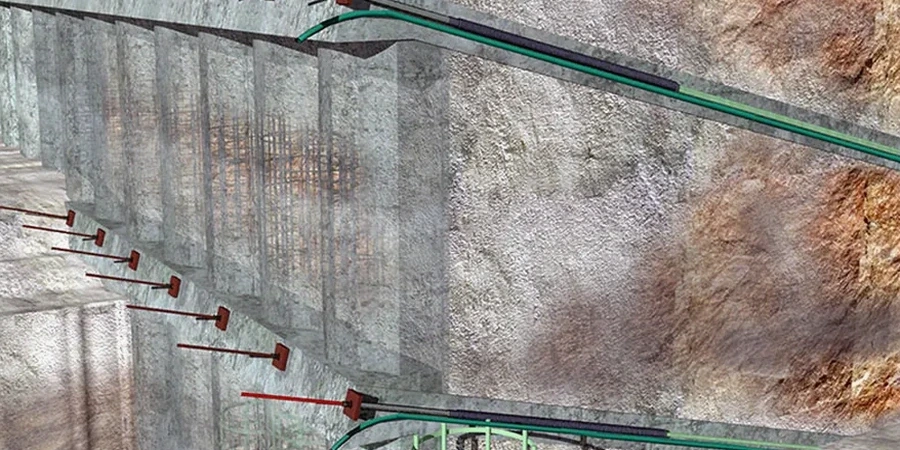
We design active prestressed tiebacks for soldier pile and lagging walls adjacent to existing structures in neighborhoods like the Fan and Church Hill. The design sequence includes determining the unbonded length behind the Rankine failure wedge, sizing the grouted bond zone within the Potomac Formation or granite bedrock, and specifying lock-off loads that balance wall deflection against tendon relaxation.
Passive Soil Nail Systems
For cut slopes along the James River bluffs and approach ramps to the Powhite Parkway, we specify fully grouted passive nails that densify and reinforce the in-situ soil mass. Our analysis uses SNAIL or SLOPE/W to verify global stability and facing connection capacity, accounting for the low effective cohesion of Richmond's residual sandy silts during heavy rainfall events.
Proof Testing and Long-Term Monitoring
Every anchor installation in Richmond's Piedmont geology demands performance verification. We supervise load tests per ASTM D3689, measuring creep rates under sustained load to confirm that the grout-ground bond has engaged in competent material. For permanent anchors supporting bridge abutments or dam tie-downs, we implement remote load cell monitoring that tracks tendon force over multiple freeze-thaw cycles.
Common questions
What factors in Richmond's geology dictate whether we need active or passive anchors?
The decision typically comes down to allowable movement. In Richmond's residual saprolite and alluvial clays, passive systems like soil nails require some deformation—often 0.5 to 2 inches at the top of the excavation—to mobilize full resistance. If you're excavating next to a century-old masonry building in Shockoe Slip, that amount of movement is unacceptable, so we specify active tiebacks prestressed with hydraulic jacks to lock in the reaction force before the wall deflects. The presence of the Petersburg Granite at shallow depth, common west of Boulevard, also favors active rock anchors because the rock-concrete bond can sustain high prestress loads without creep.
How much does anchor design and testing cost for a typical Richmond commercial excavation?
For a mid-size commercial excavation in Richmond requiring design, load testing, and construction oversight, anchor engineering fees generally fall between US$980 and US$4,190, depending on the number of anchors, the complexity of the subsurface profile, and the required corrosion protection class. Permanent encapsulated tendons for a bridge abutment will be at the higher end of that range due to the additional QA/QC documentation and longer proof-test hold durations required by PTI DC35.1.
What corrosion protection does a permanent anchor need in Richmond's soils?
Richmond's warm, humid climate and the moderate resistivity of its residual soils create a corrosive environment classified as moderately aggressive per FHWA guidelines. For any permanent anchor—defined as having a service life beyond 24 months—we specify Class I corrosion protection. This means a fully encapsulated tendon inside a corrugated plastic sheath, with the strand interstices filled with grease or grout, and a factory-sealed anchorage head. Temporary tiebacks used during a 6-month excavation can often use Class II protection, which relies on the alkaline grout cover alone.
How do you confirm the anchor bond zone is in competent rock and not weathered saprolite?
We cross-reference three data sources during installation. First, the drilling log records penetration rate and flush return color—sudden drops in rate combined with grayish-white rock flour typically indicate the granite contact. Second, we correlate the borehole depth with a pre-construction seismic refraction or MASW profile that maps the compressional wave velocity gradient at the soil-rock interface. Third, during proof testing, we monitor creep rate under sustained load: a tendon bonded in saprolite will exhibit progressive creep exceeding 2 mm per log cycle of time, while one socketed in competent granite stabilizes below 1 mm. If the creep threshold is exceeded, we extend the bond length deeper and retest.