Richmond's geology splits between crystalline Piedmont uplands and deep alluvial terraces along the James River. The fall line cuts straight through the city. Slope angles that look stable in dry weather fail when residual saprolite gets saturated. We see this pattern repeat from Church Hill to the Manchester bluffs. A test pits investigation reveals the true depth of colluvium before any cut or fill design. For slopes exceeding 2H:1V, we also run an in-situ permeability test to determine the perched water table response during heavy Mid-Atlantic storms — the real trigger for most shallow failures in Henrico and Chesterfield border zones.
A slope stability model is only as good as its pore pressure input. In Richmond's saprolite, perched water kills the factor of safety.
Technical details of the service in Richmond Virginia
- Limit equilibrium modeling (Spencer, Morgenstern-Price) with search grid refined to 0.5 m
- Phreatic surface definition from vibrating-wire piezometer data, not assumed drawdown
- Seismic coefficient kh = 0.15 per IBC site class D, verified against ASCE 7-22 Chapter 11 spectra
- 3D slope modeling (LEM or FEM) where benches, corners, or surcharge loads break the plane-strain assumption
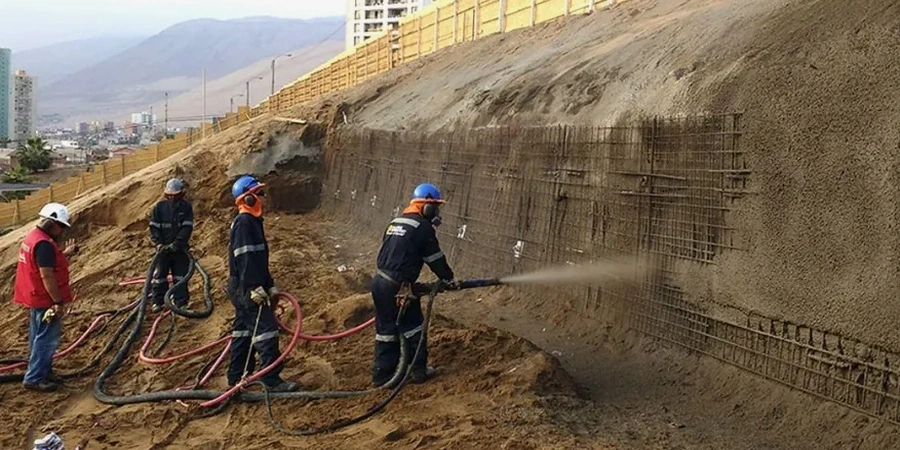
Critical ground factors in Richmond Virginia
Richmond's 20th-century expansion pushed residential subdivisions onto cut-and-fill terrain that nobody characterized properly. The Maymont Park slopes and the bluffs behind Hollywood Cemetery are living case studies in progressive creep. When fill is placed over old gully lines without keying into competent material, the contact becomes a preferential seepage path. Add a 100-year storm event — Richmond logged 6.2 inches in 6 hours during Gaston in 2004 — and the factor of safety drops below unity in minutes. The IBC now requires a slope stability evaluation for any grading that creates a slope higher than 12 feet within a critical gradient zone. Ignoring that requirement exposes the geotechnical consultant and the developer to joint liability if a failure damages property or interrupts a public right-of-way.
Our services
We deliver slope stability packages that match the review expectations of Richmond's Department of Public Works and the surrounding counties. Each report includes the design cross-section with the critical failure surface, the pore pressure justification, and the seismic pseudostatic verification.
Global stability of cuts and fills
Circular and block search analysis for proposed grading. We deliver the critical FoS and the required reinforcement scheme if the target is not met.
Seismic slope assessment
Pseudostatic analysis with kh derived from site class and mapped spectral acceleration. We check both the crustal and the Central Virginia Seismic Zone scenarios.
Back-analysis of existing failures
Field mapping of the scarp, piezometer installation, and strength back-figured from the failure geometry. Used to design the repair and prevent recurrence.
Reinforcement design
Soil nail, tieback anchor, or shear key dimensioning when the unreinforced FoS is insufficient. We coordinate the facing design with the structural team.
Common questions
What is the minimum factor of safety required by Richmond building officials?
The IBC, adopted by the City of Richmond, requires a minimum static factor of safety of 1.5 for permanent slopes. Temporary construction slopes can be designed to 1.3, provided the cut is open less than 6 months and is not exposed to a rainy season. Seismic pseudostatic analysis must achieve at least 1.1. Some VDOT projects in the right-of-way demand 1.2 seismic, so we verify the specific permit conditions.
How much does a slope stability analysis cost for a residential lot in Richmond?
A site-specific slope stability analysis for a single residential lot in the Richmond area typically falls between US$1,260 and US$4,710. The spread depends on the slope height, whether existing borings are available, and if the review requires a 3D analysis due to complex geometry. Projects needing piezometer installation and several weeks of monitoring fall toward the upper end.
Do you run finite element or limit equilibrium for Richmond saprolite slopes?
We use both. Limit equilibrium with Spencer's method gives a fast and defensible FoS for most cases. We switch to finite element (PLAXIS 2D/3D) when the slope has a complex phreatic surface, a structural facing, or when we need to estimate deformations — for example, adjacent to an existing retaining wall along Monument Avenue where differential movement matters.