Richmond’s architectural fabric stretches across a fall line where hard Piedmont metamorphic rock meets the unconsolidated sediments of the Atlantic Coastal Plain. This abrupt transition shaped the city’s industrial growth along the James River and created a subsurface patchwork that challenges conventional seismic design. Most structures here rest on varying thicknesses of alluvium, residual silts, and weathered schist, conditions that amplify ground motion differently from one block to the next. Base isolation seismic design offers a practical strategy for critical facilities, healthcare buildings, and historic retrofit projects where drift limits and operational continuity after an earthquake govern the structural program. Our team approaches each Richmond site with detailed geotechnical profiling, including seismic microzonation when the site straddles two distinct soil classes, and correlates shear wave velocity profiles with ASCE 7-22 Section 11.4 demands to define isolation system parameters grounded in local stratigraphy.
An isolation system designed without site-specific soil damping and basin-effect adjustments can underperform by 30 percent or more in Richmond’s alluvial corridors.
Technical details of the service in Richmond Virginia
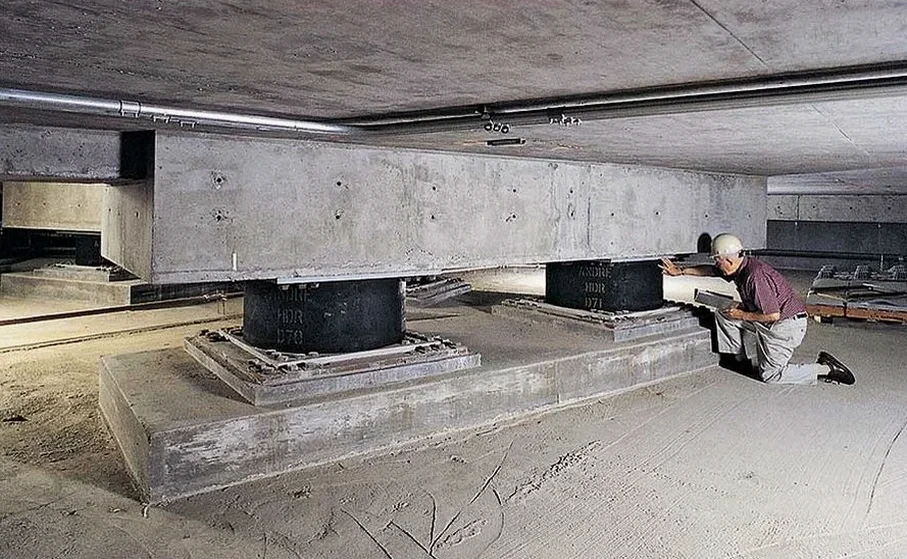
Critical ground factors in Richmond Virginia
The Central Virginia Seismic Zone produces moderate-magnitude events with relatively shallow focal depths, typically 5 to 12 kilometers, which concentrate energy in short-period structures but can still impose large displacement demands on isolated buildings when basin resonance is triggered. Richmond’s Shockoe Creek alluvial valley and the low-lying industrial tracts south of the river sit on 40 to 80 feet of soft Holocene deposits that exhibit fundamental periods matching the 1.5-to-2.5-second range common to many base-isolated frames. This period coincidence, combined with the impedance contrast at the sediment-bedrock interface mapped in several Virginia Tech geophysical studies, creates a credible scenario for amplified spectral ordinates at the isolation plane. A design that omits this basin-edge effect risks isolator pounding against the moat wall, unexpected uplift in corner devices, and exceedance of the code-allowed stability ratio under maximum considered earthquake loading. The liquefaction assessment requirement in IBC Section 1803.5.12 becomes critical because even a few inches of differential settlement beneath an isolation pedestal can compromise the uniform distribution of vertical load across the bearing array.
Our services
Our Richmond base isolation seismic design workflow runs from initial geotechnical characterization through peer review of the isolation system. We deliver the site-specific ground motion package, the soil-structure interaction parameters, and the verification testing protocol that the structural engineer of record requires.
Site-Specific Ground Motion Analysis
Development of uniform hazard spectra, conditional mean spectra, and spectrally matched acceleration time histories calibrated to the Richmond basin geometry. We incorporate deep shear wave velocity profiles and account for aleatory variability in the alluvial fill.
Geotechnical Input for Isolator Design
Determination of dynamic soil stiffness and damping at the foundation-isolator interface, including impedance functions for mat and individual spread footings supporting lead-rubber or friction pendulum isolators.
Prototype and Production Testing Oversight
Witness testing per ASCE 7-22 Section 17.8 at accredited laboratories, verifying isolator properties under prototype loads, aging effects, and scragging recovery before production acceptance.
Peer Review and Richmond Building Code Coordination
Third-party technical review of the isolation design package and direct coordination with the City of Richmond building official on alternative means and methods submissions under IBC Section 104.11.
Common questions
What does a base isolation design package typically cost for a Richmond project?
For a mid-rise essential facility in the Richmond area, the complete geotechnical and seismic isolation analysis package generally falls between US$3,730 and US$9,100, depending on the number of ground motion scenarios required and whether nonlinear time-history analyses are needed for the isolation system.
How does Richmond’s fall line geology affect the isolation system period?
East of the fall line, thick Coastal Plain sediments push the site fundamental period into the 0.8–1.5 second range, which can couple with the isolation system’s effective period near 2.0 seconds. This coupling amplifies spectral displacement demands, so we adjust the isolator yield strength and post-elastic stiffness to shift the combined period away from the basin resonance peak.
Is base isolation feasible for historic masonry buildings in the Shockoe district?
Yes, but it requires careful sequencing. We typically install a temporary support system, cut the foundation at the plinth level, and place flat sliding isolators with low activation force to avoid overstressing the unreinforced masonry. The ASCE 41-23 provisions for historic structures guide the performance objectives and the isolation retrofit acceptance criteria.
What laboratory testing do you specify for the isolation bearings?
We follow the ASCE 7-22 prototype test matrix, which includes three fully reversed cycles at increasing displacement amplitudes up to the maximum considered earthquake displacement, plus aging and environmental exposure tests per the elastomeric bearing standard. Every production bearing undergoes a short-duration compression and shear test before shipment.