Designing pile foundations in Richmond means navigating two very different soil worlds. Over in the Fan District and downtown, the ground is underlain by the Petersburg Granite — shallow rock that can make driven piles feel like hitting a wall before you reach design depth. But cross the James River into Manchester or head east toward the Henrico flatlands, and you’re dealing with thick Coastal Plain sediments: layers of marine clay, loose silty sand, and decomposing mica schist that offer almost no skin friction near the surface. We see this contrast on projects every month. A pile that works perfectly on West Broad Street might be completely under‑sized for a warehouse near I‑295. Our laboratory runs full geotechnical characterization on samples pulled from each stratum, feeding that data directly into axial capacity models so the pile section, length, and installation method match the specific geology of your Richmond site — not a generic textbook case. Complementing deep foundation work, our CPT testing provides continuous tip resistance and sleeve friction profiles that help refine bearing layer selection before the first pile goes in.
In Richmond’s Fall Zone, the distance from competent rock can change 30 feet within the same block — pile design here is never a copy‑paste job.
Technical details of the service in Richmond Virginia
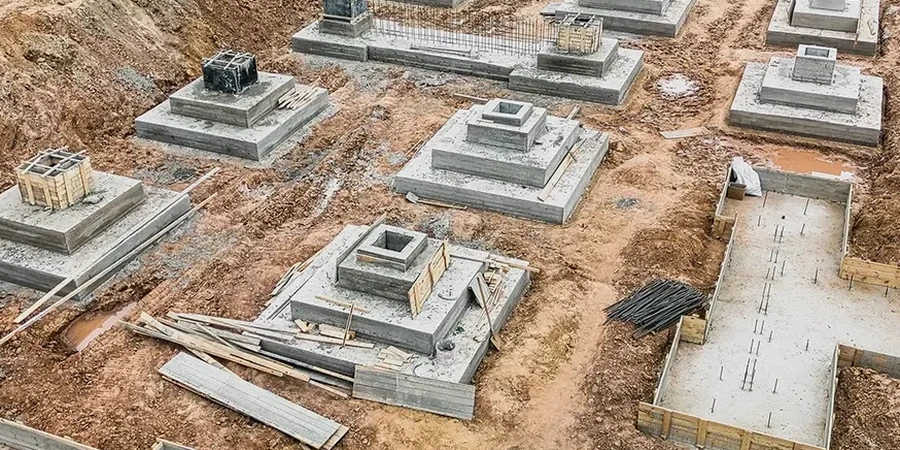
Critical ground factors in Richmond Virginia
The single most expensive mistake we see contractors make around Richmond is assuming the weathered rock layer at 25 or 30 feet is competent enough to serve as a pile tip bearing stratum. It’s not. The decomposed granite and mica schist that sit on top of the Petersburg Granite can look solid in an SPT split spoon but will compress under sustained load, leading to unacceptable total settlement — sometimes inches — after the superstructure is up. We’ve been called in to diagnose cracking in tilt‑up warehouses near the airport where the original pile design stopped in that transition zone. A proper pile foundation design pushes through the weathered zone and sockets into fresh, unweathered rock, or it relies entirely on skin friction in the overlying residual soils if the rock is too deep. Either way, the decision comes from laboratory‑verified strength parameters, not from visual classification of cuttings at the rig. Another local hazard in Richmond’s Shockoe Valley and old mill districts is buried organic silt and wood debris, which generate methane and long‑term consolidation settlement that can drag piles down with the surrounding soil if the neutral plane isn’t properly calculated.
Our services
Our pile design process in Richmond is built around the geologic reality of the Fall Zone. Before we recommend a pile type, we define the subsurface profile with enough resolution to make a defensible engineering decision.
Geotechnical Site Investigation
Rotary wash borings and hollow‑stem auger drilling through Coastal Plain and Piedmont formations. We log the transition from residual soil to weathered rock to competent granite, installing monitoring wells where groundwater affects pile installation.
Advanced Laboratory Testing
CU triaxial, one‑dimensional consolidation, and direct shear on undisturbed samples from each bearing stratum. We run chloride and sulfate panels on groundwater to specify concrete mix design and steel casing protection for long‑term durability.
Pile Capacity and Settlement Analysis
Static analysis using FHWA alpha/beta methods for cohesive layers and Nordlund/Thurman for granular strata. We model t‑z and Q‑z curves to predict settlement under your column loads, checking group effects and downdrag where fill or compressible clay is present.
Pile Driving or Installation Monitoring
Weapon and wave equation analysis for driven piles, with CAPWAP on restrike to confirm setup and capacity gain. For augered cast‑in‑place piles, we specify and witness quality control on concrete placement, ensuring no necking in the saturated Richmond soils.
Common questions
How deep do piles need to go in Richmond to reach competent rock?
It varies dramatically by neighborhood. Downtown and the Fan District often hit the Petersburg Granite between 20 and 50 feet. But in eastern Henrico or near the airport, competent rock can be 80 to over 120 feet down. We never assume a depth — our borings tell the story for your specific site.
What does pile foundation design cost for a typical Richmond commercial building?
For a mid‑sized commercial structure requiring a geotechnical investigation, laboratory testing, and a complete pile design report, budgets typically range from US$1,800 to US$5,810. The spread depends on the number of borings, whether triaxial testing is needed, and the complexity of the seismic analysis.
Do you handle both end‑bearing and friction pile designs?
Yes, and many Richmond sites require a combination. Where rock is shallow we design for end‑bearing, but in the deep Coastal Plain sediments east of the city, we often design friction piles with very conservative settlement predictions, using load‑transfer methods calibrated to our lab data.
How does the high water table near the James River affect pile installation?
It complicates drilling and concrete placement significantly. We specify temporary casing or drilling fluid to keep the hole open through saturated sands. For cast‑in‑place concrete piles, we require tremie placement and often cross‑hole sonic logging to verify shaft integrity through the groundwater zone.