Richmond's road network expanded rapidly after the 1950s annexation of South Richmond, but the underlying geology didn't change. The city sits on a mix of Piedmont residual soils west of the Fall Line and Coastal Plain sediments to the east. That transition creates a pavement design headache: one side of town gives you stiff silty clays, the other loose marine sands. We run the CBR test for road design to nail down subgrade strength before asphalt goes down, because what works on the granite-derived soils near Monument Avenue fails completely three miles east. Our lab on the Southside runs ASTM D1883 procedures daily, and we've tested material from the Powhite Parkway, Route 5, and dozens of commercial pads around Short Pump. The CBR value anchors the entire pavement section, so getting it right from undisturbed samples matters.
A soaked CBR of 3 or less on Richmond's marine clays means you're excavating and replacing subgrade, no way around it.
Technical details of the service in Richmond Virginia
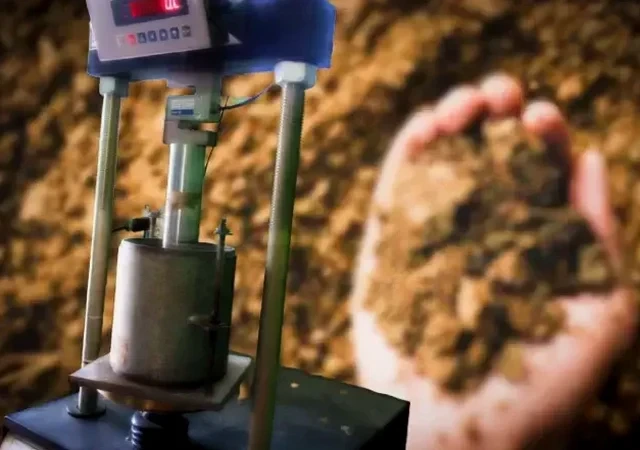
Field demonstration
Critical ground factors in Richmond Virginia
Richmond sits at 45 meters elevation on the James River, but the real number that matters for pavement is the groundwater table. Much of the eastern metro area has seasonal high water within 2 feet of the surface. If you design pavement using CBR values from dry samples, the subgrade fails within two freeze-thaw cycles. We've seen warehouse parking lots in eastern Henrico develop 4-inch ruts in under 18 months because the geotech report used unsoaked CBR. The soaked condition is not optional, it's the only value that matters for design. A CBR below 3 means you're looking at lime stabilization, geogrid, or full-depth reclamation before you even think about base course. VDOT's Road Design Manual spells this out clearly, referencing AASHTO 1993 pavement design methods. Skip the soak, and you own the failure.
Our services
Our Richmond lab handles the full CBR workflow from sample receipt to pavement design input. We don't just run the test and send a number; we interpret it against VDOT requirements and your project's traffic loading.
Soaked CBR per ASTM D1883
Complete 96-hour soak with swell measurement, load-penetration curves, and corrected CBR values at 0.1 and 0.2 inches. For VDOT, commercial, and residential pavement design.
Compaction-curve development
We run the Proctor first to establish maximum dry density and optimum moisture, then compact your CBR specimens at target percentages. Essential for accurate remolded CBR values.
Subgrade stabilization recommendations
When CBR falls below 3, we provide lime or cement stabilization mix designs with treated CBR values, saving you from costly over-excavation in Richmond's marine clay zones.
Common questions
How much does a laboratory CBR test cost in Richmond?
A single-point soaked CBR test, including the Proctor compaction curve, runs between US$140 and US$220. Three-point CBR sets for full design curves are priced proportionally. We quote per project based on sample count and turnaround needs.
How long does the CBR test take?
Standard turnaround is 5-7 business days. The 96-hour soak is the longest step. We can expedite to 4 days for an additional fee if your paving schedule is tight. We email the load-penetration curves and final CBR values as soon as the test completes.
Can I use bag samples for a CBR test?
No. Bag samples lose the in-situ density and moisture condition. You need undisturbed Shelby tubes or we remold at a specified density from a Proctor curve. If you're not sure how to sample, call us before mobilizing. We'll walk your crew through the right tube diameter and depth for Richmond's soils.